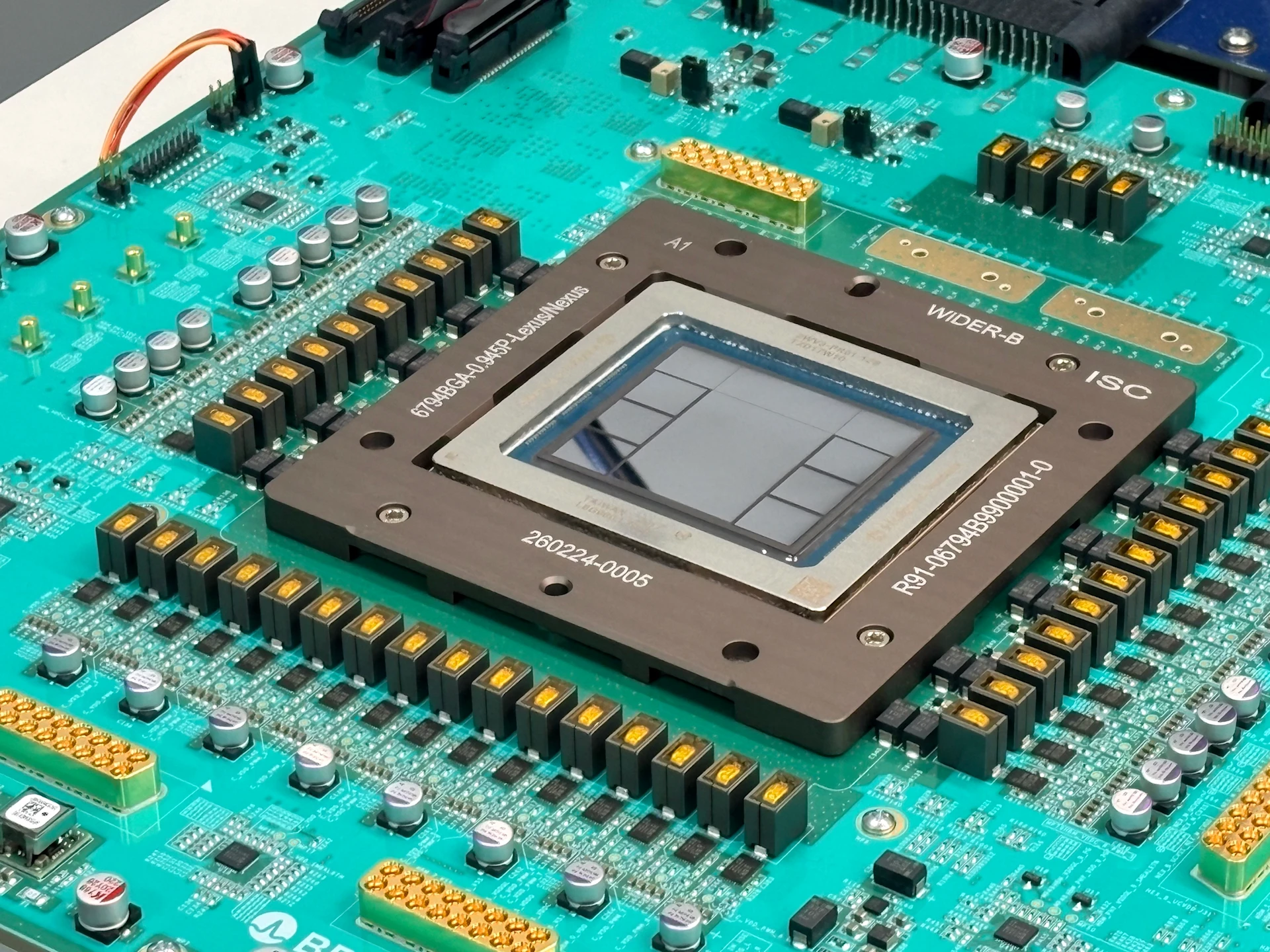

1. Introduction — OpenAI Is Building Its Own AI Silicon
OpenAI is moving deeper into the physical hardware layer. The company is no longer just training frontier foundation models; it is systematically engineering the entire compute stack:
At the Hot Chips 2026 conference, OpenAI unveiled the first performance benchmarks for Jalapeño, its custom in-house AI inference chip co-developed with Broadcom. Jalapeño represents OpenAI’s first dedicated hardware designed specifically to serve deployed models at massive scale.
This milestone establishes a critical question for enterprise AI infrastructure: Can a specialized inference processor outperform NVIDIA’s general-purpose GPUs on production serving workloads?
OpenAI’s initial benchmarks on the public InferenceX suite indicate yes—particularly in power efficiency, interactive latency, and throughput per watt.
2. What Is OpenAI’s Jalapeño Chip?
Jalapeño is a custom Application-Specific Integrated Circuit (ASIC) engineered exclusively for AI model inference—the computational process of running a trained model to answer user prompts, generate code, and execute multi-step agent reasoning.
| Compute Category | Primary Goal | Hardware Demands | Role of Jalapeño |
| Model Training | Teach models via massive datasets over weeks/months | Heavy FP8/FP16 matrix math, massive distributed scaling | No (Handled by NVIDIA GPUs) |
| Model Inference | Serve live requests to millions of concurrent users | Low latency, high memory bandwidth, high energy efficiency | Yes (Primary purpose of Jalapeño) |
Jalapeño is not built to train new models from scratch. General-purpose GPUs like NVIDIA’s Blackwell architecture remain essential for training pipelines. Jalapeño’s sole mission is serving live requests at the lowest possible power footprint and latency.
3. Why OpenAI Built Its Own AI Chip
The economics of production AI have reached an inflection point where serving existing models consumes far more aggregate compute than training them.
As multi-step AI agents generate millions of sequential tokens per session, electricity availability and operational expenses dictate how fast a platform can scale. For hyper-scale operators, raw peak compute matters less than useful AI work delivered per watt.
OpenAI engineered Jalapeño to solve this operational bottleneck directly:
- Flattening power overhead: Jalapeño is rated at a 700W package limit, but sustained power draw remained at or below 550W during benchmark workloads.
- Improving token margins: Delivering more tokens per kilowatt drives down cost-per-query for end users and enterprise API customers.
- Minimizing agent lag: Slashing token generation latency prevents agentic reasoning workflows from stalling out during complex tool calls.

4. Jalapeño vs NVIDIA: What the Benchmarks Actually Show
Benchmarking hardware on inference requires balancing speed, batch throughput, and power draw. Using the public InferenceX benchmark suite maintained by SemiAnalysis, OpenAI tested engineering silicon of Jalapeño against deployed NVIDIA Blackwell GB300 systems.
| Performance Metric | Jalapeño Advantage vs. Comparison Systems |
| AI Work Delivered Per Watt | 1.5× to 1.9× higher |
| End-to-End Latency | 1.7× to 3.6× lower |
| Highly Interactive Workloads | 2.1× to 4.1× higher performance |
| Single-User Interactive Decode | >700 tokens/second (DeepSeek R1) |
Why “4× Faster” Requires Real-World Context
A 4.1× peak figure does not mean Jalapeño outpaces an entire NVIDIA cluster across every general computing scenario. Instead, it reflects highly interactive, single-user latency-critical workloads where standard GPU architectures hit memory stalls. By optimizing its hardware pipeline specifically for live user interactions, Jalapeño occupies a superior position on the inference Pareto frontier.

5. The AI Models Used in the Benchmark
To confirm that Jalapeño’s architectural performance was not an internal artifact of OpenAI’s own model architecture, the silicon was evaluated across three distinct open-weight and external models.
- GPT-OSS 120B: Demonstrates optimal dense and MoE efficiency on OpenAI’s open architectural formats, handling low-latency interaction seamlessly.
- DeepSeek R1 670B: Demonstrates that Jalapeño excels on ultra-large, external open-weight architectures, delivering over 700 tokens per second per user in low-latency single-concurrency environments.
- Kimi K2.5 1T: Validates performance at the 1-trillion parameter scale, showing a 1.5× boost in peak performance per watt and a 3.4× reduction in end-to-end latency.
OpenAI noted that Jalapeño’s lead expanded even further on internal frontier reasoning models, confirming that the architecture scales efficiently alongside model complexity.

6. The Architecture: Why Jalapeño Is Different
Language model inference consists of two fundamentally distinct operational phases:
- Prefill Phase: The system ingests and processes the user’s initial prompt. This step is heavily compute-bound and requires raw matrix calculation power.
- Decode Phase: The model generates output tokens one by one. This step is memory bandwidth-bound, as model weights and memory cache must be loaded repeatedly for every generated token.
Conventional GPU clusters often encounter throughput penalties as they switch between compute-intensive prefill and memory-intensive decode operations across separate networked dies.
Jalapeño addresses this with a unified, fungible chip architecture. Built on TSMC’s 3nm process node in collaboration with Broadcom, the chip keeps the Key-Value (KV) cache and active model state local to the execution units. This reduces off-chip data movement, prevents idle cycles, and allows the chip to handle dynamic agentic token streams without stalling.
7. HBM4: The Memory Behind Jalapeño
AI inference performance is dictated by memory bandwidth. Large language models spend significant execution time shuttling billions of weights between storage and compute dies.
Jalapeño addresses memory bottlenecks with advanced high-bandwidth memory specifications:
- Memory Capacity: 216 GB of next-generation HBM4 across 6 stacks per package.
- Memory Bandwidth: Up to 15.4 TB/s of aggregate throughput.
This setup ensures that massive KV caches for reasoning models remain resident on ultra-fast memory, allowing Jalapeño to maintain peak decoding speeds without running into memory bus contention.
8. OpenAI Designed the Chip With AI
In a notable shift for hardware engineering, OpenAI utilized internal frontier AI models to help design the processor that will run future AI workloads:
- Rapid 9-Month Tapeout: Advanced code generation models automated design verification, architectural exploration, and simulation loops.
- Arithmetic Circuit Optimization: AI models helped lay out arithmetic logic paths to extract higher compute density within the 700W power envelope.
- AI-Generated Software Kernels: Using Codex with GPT-Astra, OpenAI generated optimized production kernels for new models in under two months.
For selected GPT-OSS attention and Mixture-of-Experts (MoE) blocks, AI-generated kernels ran 1.5× to 1.8× faster than expert-written human code, illustrating a compounding design cycle where AI models optimize their own underlying hardware.
9. Why Jalapeño Matters for AI Agents
Autonomous AI agents do not simply generate a single paragraph; they reason, write code, run tools, read outputs, and iterate:
Because an agent might execute 10 to 30 sequential model calls to complete a single task, even minor millisecond delays compound into noticeable lag for the user. Jalapeño’s ability to run single-user decoding at hundreds of tokens per second significantly cuts wait times for agentic workflows, making multi-step automation viable in enterprise production.
10. Does Jalapeño Really Threaten NVIDIA?
Jalapeño represents targeted competition in production inference, but it does not displace NVIDIA’s enterprise ecosystem:
Where Jalapeño Excels
- Inference Power Efficiency: Higher work per watt on dedicated language model serving.
- Tailored Workloads: Optimized around real-time interactive generation and agentic latency.
- Cost Controls: Lowers OpenAI’s internal operating cost per token.
Where NVIDIA Remains Dominant
- Model Training: Blackwell and future GPU platforms remain the baseline for large-scale model pre-training.
- Ecosystem Maturity: NVIDIA’s CUDA platform supports any model architecture out of the box with extensive library support.
- Broad Workload Flexibility: General-purpose GPUs excel across computer vision, physics simulations, and multimodal training pipelines simultaneously.
OpenAI explicitly confirmed that it will continue buying and deploying large volumes of NVIDIA GPUs alongside its own custom accelerators.
11. Jalapeño vs. NVIDIA Blackwell vs. NVIDIA Rubin
| Feature / Metric | OpenAI Jalapeño | NVIDIA Blackwell (GB300) | NVIDIA Rubin |
|---|---|---|---|
| Primary Workload | Dedicated Inference | Training & Inference | Next-Gen Training & Inference |
| Silicon Type | Custom ASIC | General-Purpose GPU | General-Purpose GPU |
| Memory Standard | HBM4 (216 GB) | HBM3E | HBM4 |
| Memory Bandwidth | Up to 15.4 TB/s | ~8.0 TB/s | Expected >15–20 TB/s |
| Deployment Target | OpenAI Internal Compute | Broad Commercial Availability | Enterprise & Cloud Scale |
While Jalapeño outpaces previous-generation systems on inference metrics, NVIDIA’s upcoming Vera Rubin architecture—which also integrates HBM4—will represent the true battleground for next-generation data center efficiency.
12. OpenAI’s Full-Stack AI Infrastructure Strategy
Jalapeño solidifies OpenAI’s transition into a vertically integrated technology firm. Rather than relying entirely on third-party hardware vendors, OpenAI now co-designs every layer of the compute chain:
- Algorithms & Models: GPT-4, o-series reasoning models, and GPT-OSS.
- Serving Software: Custom compiler stacks and AI-generated Triton/C++ kernels.
- Silicon Architecture: Custom inference ASICs with Broadcom.
- Physical Deployment: High-density rack systems integrated directly into partner data centers.
This vertical integration mirrors Apple’s silicon strategy in consumer devices and Google’s TPU approach in cloud infrastructure, granting OpenAI stronger price leverage and greater hardware control.
13. Deployment Timeline and Future Generations
OpenAI plans to deploy initial Jalapeño units within its production compute fleet by late 2026.
Jalapeño is not a one-off experiment; it marks the start of a multi-generational hardware roadmap:
- Generation 1 (Jalapeño): Entering initial infrastructure production qualification.
- Generation 2: Final engineering design tapeout expected within months.
- Generation 3: Conceptual architecture and system-level modeling underway.
14. What Jalapeño Means for the AI Chip Industry
The arrival of functional custom silicon from OpenAI accelerates a wider market shift:
- NVIDIA: Faces stronger pressure in high-volume inference, where hyperscalers want alternatives to high-margin GPUs.
- Broadcom: Reaffirms its position as the premier custom ASIC co-design partner for top-tier software labs.
- Cloud Hyperscalers (Google TPU, AWS Trainium, Microsoft Maia): Validates the trend toward specialized first-party silicon over standard merchant silicon.
- The AI Industry: Establishes that the most competitive AI labs will run proprietary silicon tailored to their own model topologies.
15. Conclusion — The AI Infrastructure Race Is Changing
Jalapeño does not eliminate NVIDIA from the data center, but it marks an important structural shift in how AI compute is provisioned. The competitive landscape is expanding beyond who trains the most capable weights to who can serve those weights with the lowest latency and smallest electrical footprint.
As inference requests continue to outpace training compute, custom architectures like Jalapeño will play a central role in making frontier AI models economically sustainable at planetary scale.
Frequently Asked Questions (FAQs)
What is the OpenAI Jalapeño chip?
Jalapeño is OpenAI’s first custom-designed AI processor (ASIC), co-developed with Broadcom. Built on TSMC’s 3nm process with HBM4 memory, it is engineered specifically to accelerate and serve AI model inference at lower latency and higher power efficiency.
Can Jalapeño train AI models like GPT-5?
No. Jalapeño is an inference-only accelerator designed to generate responses and run reasoning agents. OpenAI will continue using NVIDIA GPUs and other commercial accelerators for pre-training large models from scratch.
How does Jalapeño compare to NVIDIA Blackwell?
According to public InferenceX benchmarks, Jalapeño delivers 1.5× to 1.9× more AI work per watt and 1.7× to 3.6× lower end-to-end latency compared to NVIDIA Blackwell GB300 systems on tested workloads, reaching up to 4.1× higher performance on interactive agent tasks.
When will OpenAI deploy the Jalapeño chip?
OpenAI plans to begin deploying initial Jalapeño silicon into its internal data center infrastructure by late 2026, alongside ongoing development of second- and third-generation iterations.
Why did OpenAI design its own chip instead of buying more GPUs?
Inference workloads are surging alongside multi-step AI agent adoption. Designing custom ASICs allows OpenAI to lower its electrical footprint, cut per-token serving costs, and optimize hardware specifically for its model architectures.
1 thought on “OpenAI’s Jalapeño Chip: How Its Custom AI Processor Challenges NVIDIA Blackwell on Inference”