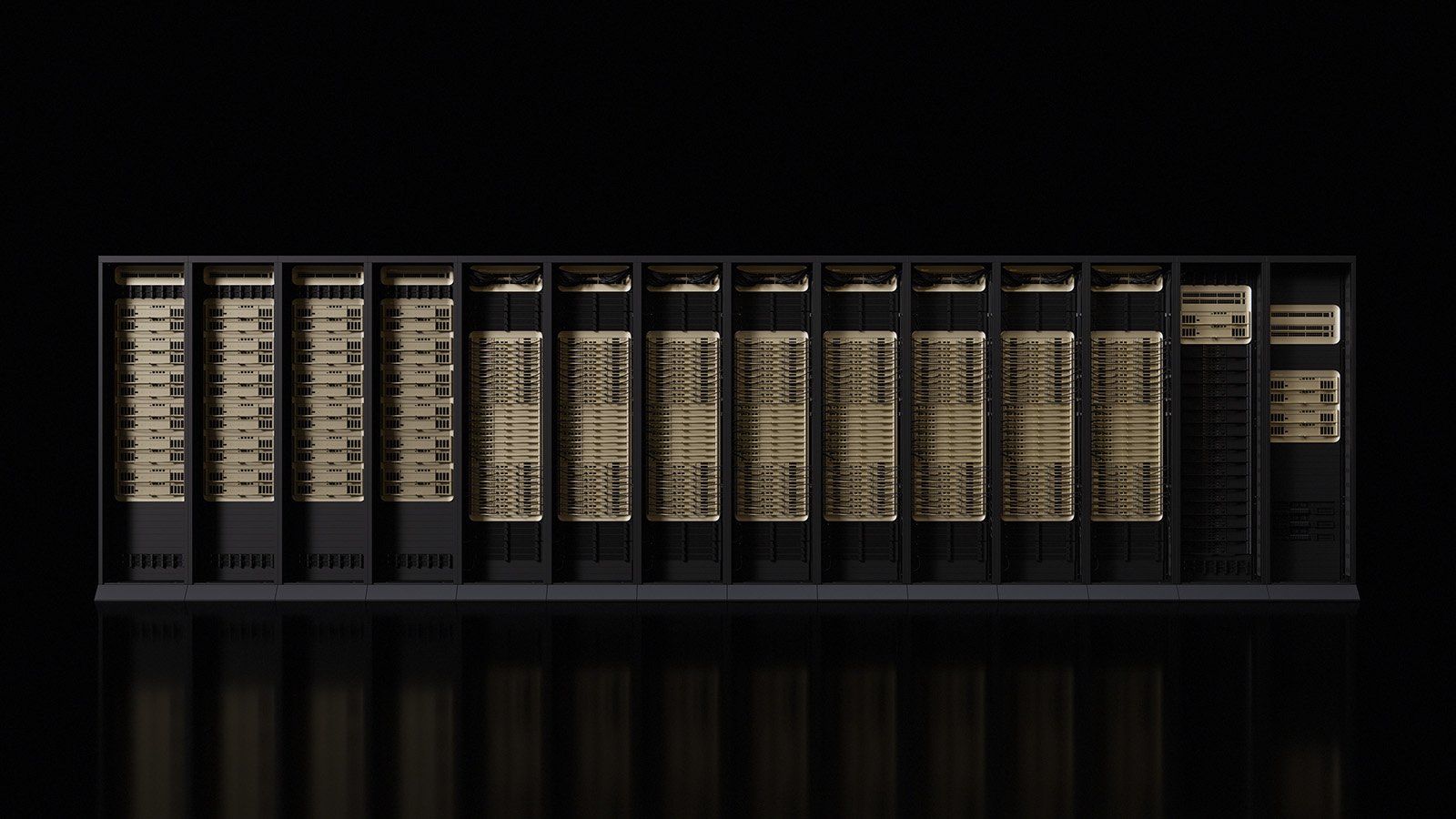

NVIDIA Rubin GPU, the economics of artificial intelligence have reached an inflection point. As frontier reasoning models execute extended test-time compute loops, multi-agent frameworks run continuous tool-use pipelines, and video models generate massive contextual volumes, inference has surpassed training as the primary operational cost for AI enterprises. Running trillion-parameter architectures at production scale under older hardware paradigms introduces unsustainable power footprints and token costs.
NVIDIA Rubin GPU generation addresses this infrastructure challenge directly. Engineered around the high-volume token economy, Rubin moves beyond isolated compute accelerators to introduce a cohesive six-chip ecosystem. Built on full platform codesign, the architecture unifies the Vera CPU, NVIDIA Rubin GPU, NVLink 6 Switch, ConnectX-9 SuperNIC, BlueField-4 DPU, and Spectrum-6 Ethernet Switch to re-engineer data center throughput from the silicon die to the rack fabric.
1. What Is the NVIDIA Rubin GPU?
The NVIDIA Rubin GPU is the architectural successor to the Blackwell platform, optimized specifically to handle large-scale inference, complex reasoning models, and agentic workflows. Named in honor of American astronomer Vera Florence Cooper Rubin, the platform tackles memory and networking bottlenecks that emerge when deploying long-context and Mixture-of-Experts (MoE) architectures at global scale.
NVIDIA Rubin GPU vs. Vera Rubin Platform
A clear architectural distinction exists between the standalone GPU and the full supercomputing platform:
- The Rubin GPU: The dedicated accelerator silicon featuring a third-generation Transformer Engine, native NVFP4 precision units, and next-generation High Bandwidth Memory (HBM4).
- The Vera Rubin Platform: An integrated, six-chip data-center supercomputer combining the Vera CPU (88 custom Olympus cores based on Armv9.2), Rubin GPU, NVLink 6 interconnect, ConnectX-9 SuperNIC (delivering up to 1.6 Tb/s per port), BlueField-4 DPU, and Spectrum-6 Ethernet switches.
Treating Rubin strictly as a graphics processing unit misses the fundamental design shift: it functions as a modular node inside a disaggregated, rack-level AI engine.
2. NVIDIA Rubin vs. Blackwell
The transition from Blackwell to Rubin expands beyond raw compute density into interconnect throughput, lower numerical precision, and KV cache handling.
| Architectural Feature | NVIDIA Blackwell | NVIDIA Rubin |
| Silicon Architecture | Blackwell | Rubin |
| Primary Workload Target | High-density training & foundational inference | Agentic reasoning, long-context inference, & MoE |
| Key Inference Precision | FP4, FP8, INT8 | Native NVFP4 with hardware adaptive compression |
| Memory Standard | HBM3e | HBM4 |
| Interconnect Standard | NVLink 5 (1.8 TB/s per GPU) | NVLink 6 (3.6 TB/s per GPU) |
| Rack-Scale Deployment | GB200 / GB300 NVL72 | Vera Rubin NVL72 |
| Total Rack NVLink Bandwidth | 130 TB/s | 260 TB/s |
| Claimed Token Economics | Baseline generation | Up to 10× lower token cost (NVIDIA platform claims) |
| Claimed MoE Training | Baseline GPU count | Up to 4× fewer GPUs required for MoE training |
Note: Stated efficiency and token cost gains reflect NVIDIA platform-level engineering projections across full NVL72 configurations rather than standardized, third-party benchmark evaluations.
3. NVIDIA Rubin GPU Architecture
The compute core of the Rubin GPU focuses on numerical compression and hardware-level token management.
Third-Generation Transformer Engine
Rubin integrates a third-generation Transformer Engine equipped with hardware-accelerated adaptive compression. Modern transformer layers fluctuate in dynamic range across token sequences; the updated engine continuously compresses activation tensors and weights during runtime without degrading output accuracy, minimizing memory traffic and maximizing tensor core residency.
NVFP4 Compute Precision
Rubin rates at 50 petaflops of NVFP4 compute dedicated to inference workloads. NVFP4 builds upon standard 4-bit floating-point math by implementing custom scaling factors, narrower mantissa/exponent structures, and fine-grained quantization groupings. This halves memory pressure compared to FP8 formats and quadruples arithmetic density relative to FP16 baselines.
4. Rubin HBM4: Why Memory Bandwidth Dictates Inference
Large language model inference splits into two operational phases: prefill (compute-bound) and decode (memory-bandwidth bound). During autoregressive token generation, weights and key-value (KV) caches must stream across memory interfaces for every single token produced.
As context windows expand from 32k to several million tokens, the KV cache grows proportionally, frequently exceeding onboard memory and saturating bus channels.
Transitioning from HBM3e to HBM4 resolves this memory wall:
- Wider Interface Routing: HBM4 moves to a 2048-bit interface per stack (doubling HBM3e’s 1024-bit bus), lowering clock power while scaling overall throughput.
- Direct Base Die Integration: Advanced packaging allows HBM4 stacks to interface with the host GPU using advanced logic processes, improving signal integrity and access latencies.
- Sustained Token Decoding: Substantially elevated gigabytes-per-second memory bandwidth prevents arithmetic execution units from idling while waiting for KV cache retrieval during agentic loops.
5. NVIDIA Rubin Performance & Inference Economics
Evaluating Rubin requires separating raw hardware FLOPS from cluster-wide throughput and cost per token.
GPU Compute Density
Operating at 50 PFLOPS of NVFP4 inference compute, an isolated Rubin GPU provides the mathematical throughput necessary to execute dense matrix operations and wide MoE routing gates with minimal latency jitter.
Platform-Level Communication
Single-GPU performance is constrained without balanced interconnects. Rubin integrates NVLink 6, doubling individual GPU bidirectional bandwidth to 3.6 TB/s. Across an entire Vera Rubin NVL72 system, total cross-chassis switching bandwidth reaches 260 TB/s—surpassing aggregate public internet traffic. This eliminates serialization stalls during all-to-all tensor routing steps in sparse MoE models.
As context windows expand from 32k to several million tokens, the KV cache grows proportionally, frequently exceeding onboard memory and saturating bus channels.
Transitioning from HBM3e to HBM4 resolves this memory wall:
- Wider Interface Routing: HBM4 moves to a 2048-bit interface per stack (doubling HBM3e’s 1024-bit bus), lowering clock power while scaling overall throughput.
- Direct Base Die Integration: Advanced packaging allows HBM4 stacks to interface with the host GPU using advanced logic processes, improving signal integrity and access latencies.
- Sustained Token Decoding: Substantially elevated gigabytes-per-second memory bandwidth prevents arithmetic execution units from idling while waiting for KV cache retrieval during agentic loops.
5. NVIDIA Rubin Performance & Inference Economics
Evaluating Rubin requires separating raw hardware FLOPS from cluster-wide throughput and cost per token.
GPU Compute Density
Operating at 50 PFLOPS of NVFP4 inference compute, an isolated Rubin GPU provides the mathematical throughput necessary to execute dense matrix operations and wide MoE routing gates with minimal latency jitter.
Platform-Level Communication
Single-GPU performance is constrained without balanced interconnects. Rubin integrates NVLink 6, doubling individual GPU bidirectional bandwidth to 3.6 TB/s. Across an entire Vera Rubin NVL72 system, total cross-chassis switching bandwidth reaches 260 TB/s—surpassing aggregate public internet traffic. This eliminates serialization stalls during all-to-all tensor routing steps in sparse MoE models.
The Shift to Token Economics
Hyperscalers and AI startups evaluate hardware based on total cost of ownership (TCO) per billion tokens served rather than peak floating-point numbers. Generating tokens at scale requires balancing:
By combining NVFP4 quantization, HBM4 bandwidth, and direct rack switching, NVIDIA targets an order-of-magnitude reduction in overall token processing expense compared to predecessor baselines.
6. Vera Rubin NVL72: The Rack-Scale Architecture
The Vera Rubin NVL72 functions as a single unified supercomputer occupying a standard footprint. The system design integrates:
- 72 NVIDIA Rubin GPUs liquid-cooled on a shared backplane.
- 36 NVIDIA Vera CPUs, utilizing 88 custom Olympus Armv9.2 cores per socket to orchestrate prompt queuing and OS scheduling without x86 bottlenecks.
- Direct NVLink-C2C (Chip-to-Chip) interconnects binding CPU and GPU memories into a coherent space.
- Cable-Free Blind-Mate Trays: A modular mechanical architecture that NVIDIA rates for up to 18× faster field assembly and maintenance turnaround over early Blackwell racks.
- Confidential Computing & Second-Generation RAS: Hardware-level hardware root-of-trust isolation across CPU, GPU, and NVLink domains, monitored continuously by a dedicated Reliability, Availability, and Serviceability (RAS) telemetry engine.
7. AI Inference Evolution: From Static Requests to Agentic Loops
AI workloads have evolved past simple single-prompt/single-response patterns toward long-running computational agents.
(ASTRA / BlueField-4)
Under agentic workflows:
- Multi-Step Planning: Models maintain internal scratchpads, running iterative checks across hundreds of dynamic steps before returning output.
- State Retention: The system caches multi-turn chat history, tool APIs, and document embeddings simultaneously.
- Dynamic Mixture-of-Experts: Routing selects distinct sub-networks per token, requiring line-rate cross-cluster communication to assemble parameters dynamically.
Rubin’s subsystem is optimized to sustain continuous agent loops without triggering memory-thrashing states.
8. BlueField-4 & The Inference Context Storage Platform
A core bottleneck in long-context inference is managing KV cache memory exhaustion across multi-turn user sessions. Rubin introduces the NVIDIA Inference Context Memory Storage Platform, managed directly by the BlueField-4 DPU.
- KV Cache Offloading & Sharing: BlueField-4 routes, shares, and reuses pre-computed KV cache matrices across distributed storage nodes, preventing GPU memory from filling with historical prompt data.
- ASTRA (Advanced Secure Trusted Resource Architecture): A hardware-isolated control plane allowing cloud operators to securely partition and multi-tenant bare-metal GPU clusters without degrading interconnect bandwidth.
9. Networking Infrastructure: Spectrum-6 & ConnectX-9
Data centers deploying tens of thousands of GPUs depend heavily on physical layer networking. The Rubin platform deploys two primary networking paths:
- NVIDIA ConnectX-9 SuperNIC: Provides line-rate network interfaces reaching up to 1.6 Tb/s, matching multi-rail requirements for extreme cluster scaling.
- Spectrum-6 Ethernet & Optical Fabrics: Operating on 200G SerDes channels, the Spectrum-6 switch platform introduces Spectrum-X Ethernet Photonics, leveraging co-packaged optics (CPO).
- Inter-Facility Scaling: Spectrum-XGS technology links physically separated data centers across long distances, allowing them to coordinate distributed jobs within a synchronized execution fabric.
10. Industry Comparison: NVIDIA Rubin vs. Competing AI Silicon
Hyperscalers and semiconductor providers continue expanding alternatives to NVIDIA’s full-stack approach.
- AMD Instinct (e.g., MI300/MI350 series): Competes with high on-package HBM capacity and competitive raw compute pricing. AMD leverages open ROCm software frameworks, though NVIDIA maintains advantages in tightly integrated proprietary networking (NVLink 6) and multi-chip codesign.
- Custom Hyperscale ASICs (Google TPU, AWS Trainium): Cloud-native accelerators offer strong price-to-performance for internal workloads (e.g., Google’s TPU infrastructure or AWS Trainium deployments). However, they lack the broad software portability and general enterprise ecosystem of NVIDIA’s CUDA stack.
- Sovereign & Neocloud Deployment: Rubin’s rack-level packaging provides turnkey deployment capability for specialized providers who require immediate time-to-market over in-house ASIC fabrication.
11. Enterprise Deployment & Hyperscaler Adoption
Major cloud providers, AI labs, and hardware original equipment manufacturers (OEMs) have confirmed plans for Rubin integration across their infrastructure stacks:
- Hyperscale Cloud Providers: Microsoft Azure (integrating Rubin into next-generation Fairwater AI superfactories), Amazon Web Services (AWS), Google Cloud, and Oracle Cloud Infrastructure (OCI).
- Specialized AI Cloud Providers: CoreWeave (managed via CoreWeave Mission Control), Lambda, Nebius, and Nscale.
- Frontier AI Research Labs: OpenAI, Anthropic, Meta, xAI, Mistral AI, Cohere, Perplexity, and Runway.
- Enterprise Server Systems: Dell Technologies (Dell AI Factory), Hewlett Packard Enterprise (HPE), Lenovo (incorporating Neptune direct liquid cooling), and Supermicro.
- Software Layer: Red Hat enterprise optimization spanning RHEL, OpenShift, and Red Hat AI.
12. Deployment Timeline & Availability
- Manufacturing Status: The Rubin architecture is in full production.
- Partner Availability: Initial partner systems and tier-one cloud provider instances featuring Rubin platforms are scheduled to roll out during the second half of 2026.
- Form Factors: Hardware will ship in both unified rack-scale Vera Rubin NVL72 units for mega-clusters and standard HGX Rubin NVL8 8-GPU boards targeting x86 hybrid environments.
13. Summary: Core Architectural Takeaways
- Complete System Codesign: Rubin integrates six discrete silicon designs (Vera CPU, Rubin GPU, NVLink 6, ConnectX-9, BlueField-4, Spectrum-6).
- Advanced Memory: Shifts the memory subsystem to HBM4, providing essential bandwidth for decode-heavy, long-context operations.
- Native NVFP4 Precision: Delivers 50 PFLOPS of inference capability using lower-precision numerical execution.
- Massive Rack Throughput: The Vera Rubin NVL72 rack yields 260 TB/s of internal NVLink 6 fabric bandwidth.
- Inference Economics: Tailored to reduce token generation costs and accelerate iterative reasoning, agentic planning, and sparse Mixture-of-Experts deployments.
Frequently Asked Questions
What is the NVIDIA Rubin GPU?
The NVIDIA Rubin GPU is NVIDIA’s next-generation AI acceleration processor following the Blackwell series. Designed on an annual release cadence, it features HBM4 memory, a third-generation Transformer Engine, and native NVFP4 precision designed for generative models, agentic workflows, and large-scale reasoning.
Is NVIDIA Rubin better than Blackwell?
Rubin expands upon Blackwell’s foundation with double the NVLink interconnect bandwidth (3.6 TB/s per GPU), an upgrade to HBM4 memory interfaces, hardware-accelerated adaptive compression, and lower-precision NVFP4 computing pipelines.
Does the NVIDIA Rubin GPU use HBM4 memory?
Yes. Rubin incorporates the HBM4 memory standard, utilizing wider 2048-bit base interfaces to supply the critical memory bandwidth required during long-context and real-time token decoding phases.
How powerful is a single NVIDIA Rubin GPU?
NVIDIA rates a single Rubin GPU at 50 petaflops of NVFP4 compute specifically dedicated to AI inference tasks.
What is the NVIDIA Vera Rubin NVL72?
The Vera Rubin NVL72 is a liquid-cooled rack-scale system. It unifies 72 Rubin GPUs and 36 custom Vera CPUs across a 260 TB/s NVLink 6 switching fabric, acting logically as a single supercomputing node.
What is the difference between the Vera CPU and the Rubin GPU?
The Vera CPU is an 88-core custom Armv9.2 central processing unit designed to handle OS operations, orchestration, and context scheduling. The Rubin GPU is the dedicated parallel accelerator that executes core matrix mathematics and transformer neural network layers.
What is NVFP4 in NVIDIA Rubin?
NVFP4 is a specialized 4-bit floating-point precision format designed by NVIDIA. It incorporates proprietary quantization strategies and scaling factors to cut memory usage in half relative to FP8, boosting execution speed without compromising model reasoning fidelity.
When will NVIDIA Rubin systems be available?
NVIDIA Rubin is currently in full production, with commercial hardware and cloud instances rolling out via hyperscalers and OEM partners across the second half of 2026.
Will Rubin completely replace Blackwell immediately?
No. Enterprise and cloud infrastructure lifecycles typically see both architectures running concurrently across hybrid tiers, with Blackwell handling sustained training/inference workloads while Rubin scales into high-density reasoning, agentic loops, and frontier deployments.
2 thoughts on “NVIDIA Rubin GPU the powerhouse: Architecture, HBM4, Performance and the Future of AI Inference”