
NVIDIA B300 vs B200, at first glance, the NVIDIA B300 looks like a conventional mid-cycle refresh of the B200—the typical “faster clock speeds and a bit more headroom” upgrade that hardware vendors push every cadence cycle. But viewing the B300 through the lens of a standard GPU refresh misses the broader tectonic shift occurring across data centers.
The baseline profile of AI computing has mutated. While 2023 and 2024 were dominated by pre-training multi-billion-parameter base models, modern production workloads prioritize test-time compute, complex agentic reasoning loops, long-context retrieval, and continuous token generation. Pre-training demands raw brute-force matrix math; reasoning demands memory capacity, massive attention-layer bandwidth, and low-latency interconnects.
NVIDIA designed the base B200 to establish the foundation of the Blackwell architecture. The B300 (branded under Blackwell Ultra) exists because generative models outgrew traditional inference constraints almost overnight.
Key Takeaway: The B200 is the bedrock of NVIDIA’s Blackwell generation, built for dense training and broad inference workloads. The B300 pushes that platform directly into reasoning-centric computing, equipping data centers with the memory headroom and attention acceleration demanded by test-time scaling.
NVIDIA B300 vs B200 at a Glance
A side-by-side comparison of official specifications highlights where NVIDIA focused its engineering budget for the Blackwell Ultra transition:
| Specification | NVIDIA B200 | NVIDIA B300 |
| Architecture | Blackwell | Blackwell Ultra |
| Silicon Design | Dual-reticle die (TSMC 4NP, 208B transistors) | Dual-reticle die (TSMC 4NP, 208B transistors) |
| Streaming Multiprocessors (SMs) | 160 SMs (up to, depending on SKU) | 160 SMs (up to, full GPU implementation) |
| GPU Memory | 180 GB HBM3E (base) / up to 192 GB | Up to 288 GB HBM3E (8 × 12-Hi stacks) |
| Memory Bandwidth | Up to 8 TB/s | Up to 8 TB/s |
| NVLink Generation | 5th Gen (1.8 TB/s bidirectional) | 5th Gen (1.8 TB/s bidirectional) |
| Dense NVFP4 Compute (Chip / 8-GPU HGX) | 10 PFLOPS / 72 PFLOPS | 15 PFLOPS / 108 PFLOPS |
| Sparse NVFP4 Compute (Chip / 8-GPU HGX) | 20 PFLOPS / 144 PFLOPS | 20 PFLOPS / 144 PFLOPS |
| Attention Compute (SFU EX2) | Baseline (5.0 TeraExponentials/s) | 2× Baseline (10.7 TeraExponentials/s) |
| Node Network Bandwidth (HGX) | 0.8 TB/s | 1.6 TB/s (via ConnectX-8) |
| Maximum Thermal Design Power (TGP) | Up to 1,200W | Up to 1,400W |
| Primary Workload Emphasis | Pre-training + general inference | Reasoning + long-context inference + agentic AI |
Note: Per-chip dense compute reflects raw silicon capabilities (10 PFLOPS on B200 vs. 15 PFLOPS on B300), while HGX configurations reflect standard production system throughput (72 PFLOPS vs. 108 PFLOPS).
What Actually Is the B200?
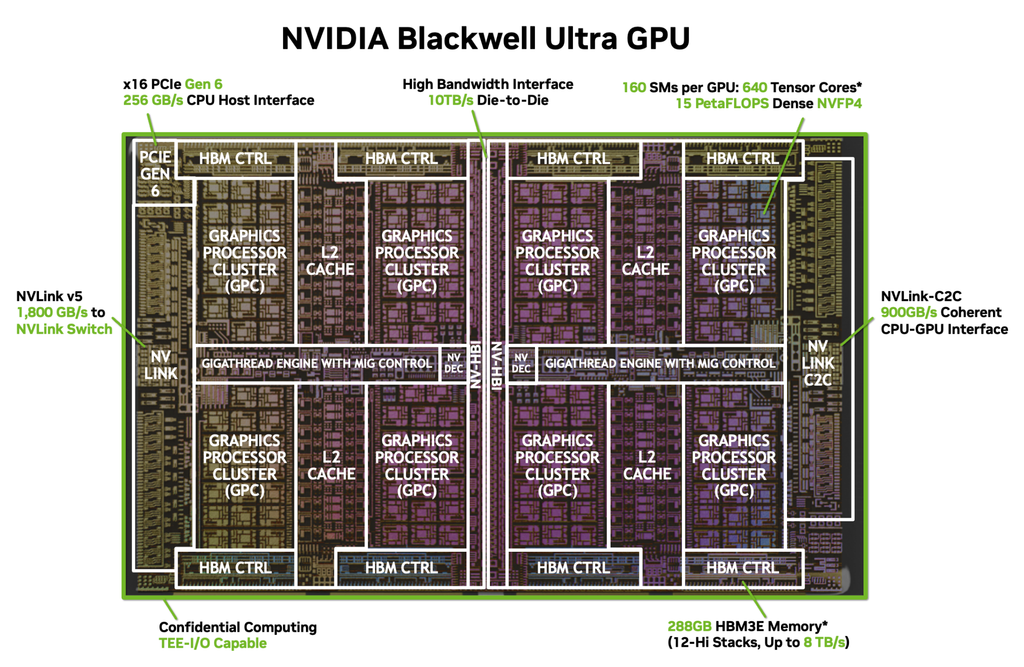
The B200 represents the debut of NVIDIA’s Blackwell family. Instead of relying on a monolithic chip layout—which has run squarely into physical reticle limits—Blackwell fuses two reticle-sized dies using NVIDIA’s High-Bandwidth Interface (NV-HBI).
NV-HBI delivers an astonishing 10 TB/s of die-to-die bandwidth, allowing 208 billion transistors manufactured on TSMC’s 4NP process to behave as a single, coherent CUDA engine.
The B200 is not meant to be evaluated as an isolated PCIe peripheral. It is a foundational node in a warehouse-scale computing topology:
- Fifth-Generation Tensor Cores: Integrated with the second-generation Transformer Engine, supporting micro-scaled FP4 (NVFP4).
- High-Bandwidth Memory: 180 GB to 192 GB of high-speed HBM3E delivering up to 8 TB/s of bandwidth.
- Scale-Up Interconnect: 1.8 TB/s bidirectional NVLink 5 pipes linking GPUs within compute trays.
- Ecosystem Parity: Immediate plug-and-play execution within CUDA, TensorRT, and NCCL.
What Is the B300?
The B300 is the flagship of the Blackwell Ultra generation. It retains the proven dual-die package and NV-HBI link of the B200, but it restructures internal execution efficiency, uncaps memory capacities, and integrates higher node-level networking.
Key refinements under the hood include:
- 288 GB HBM3E per GPU: Built on dense 12-High HBM3E stacks through an 8,192-bit interface.
- Uncapped Dense FP4 Matrix Execution: Pushing dense NVFP4 from 10 PFLOPS on base Blackwell up to 15 PFLOPS per GPU (a 50% increase).
- Hardwired Attention Engines: Upgraded Special Function Units (SFUs) that double transcendental execution speeds.
- Modern Networking Integration: Engineered natively for ConnectX-8 SuperNICs to double host-to-host bandwidth.
The Biggest Difference: Memory Capacity
The B200 features 180 GB of HBM3E, while the B300 scales to 288 GB of HBM3E. That is a 60% capacity leap on identical memory bus bandwidth (8 TB/s).
So what?
In classical deep learning, memory bandwidth dictated model training speeds. In modern agentic pipelines, raw capacity dictates system economics:
- Eliminating Tensor-Parallel Splitting: Extremely large reasoning models (such as DeepSeek-R1 or large Llama variants) cannot fit their active weights, activations, and Key-Value (KV) caches onto a small GPU cluster without heavy tensor parallelism. Splitting a model across more GPUs introduces inter-chip communication overhead. With 288 GB, larger models fit across fewer accelerators, collapsing networking bottlenecks.
- Uncapped KV-Cache for Thinking Loops: Extended reasoning models “think” before spitting out answers, often generating thousands of intermediate reasoning tokens. This balloons the KV cache. When a GPU runs out of HBM, it must offload KV caches to host system memory (CPU DRAM), completely gutting token generation speed. 288 GB keeps massive context windows and reasoning chains entirely on-chip.
Analysis: More HBM isn’t just about loading a larger parameter file. It directly cuts the total number of physical nodes required to serve a model at zero offload latency.
Compute Performance: Dense vs. Sparse Realities
Evaluating the compute differences between B200 and B300 requires looking past high-level marketing numbers.
B200 72 PFLOPS
B300 108 PFLOPS (+50%)
B200 144 PFLOPS
B300 144 PFLOPS
At the single-chip level:
- Dense NVFP4: B200 runs at 10 PFLOPS, whereas B300 achieves 15 PFLOPS (a 1.5× uplift).
- Sparse NVFP4: Both architectures cap their structural sparsity theoretical envelope at 20 PFLOPS per chip (yielding 144 PFLOPS across an 8-GPU HGX).
- FP8 Compute: 5 PFLOPS dense / 10 PFLOPS sparse per GPU on both platforms.
So what?
Structural 2:4 sparsity requires aggressive pruning that not all frontier reasoning models tolerate without minor accuracy degradation. Many production inference clusters run models strictly in dense mode. Because B300 increases dense FP4 execution by 50% (from 72 PFLOPS to 108 PFLOPS in an 8-GPU node), enterprises see a direct compute uplift without relying on model pruning tricks.
Attention Performance: The Underappreciated Difference
In standard transformer models, compute is dominated by General Matrix Multiplications (GEMMs). But as context length expands, the attention mechanism becomes a computational wall.
Attention mechanisms rely heavily on the Softmax function—which requires transcendental mathematical calculations like exponentials and divisions ($e^x$). These are not handled by standard Tensor Cores; they are dispatched to the SM’s Special Function Units (SFUs).
Lower Attention Workload
Dominated by GEMM mathMassive Attention Bottleneck
Stressed SFUs & Softmax opsNVIDIA doubled the SFU throughput for exponential operations (SFU EX2) on Blackwell Ultra, increasing throughput from 5.0 TeraExponentials/s on B200 to 10.7 TeraExponentials/s on B300.
So what?
This modification yields a 2× boost in attention performance. For long document parsing, multi-turn AI agents, and reasoning models that chew through 64k+ token context windows, the B300 avoids the severe Softmax latency cliffs that can stall inference pipelines on older hardware.
Networking: Off-Die Throughput
A data center accelerator is only as effective as the network fabric stitching it to adjacent racks.
While both the B200 and B300 deploy fifth-generation NVLink with 1.8 TB/s bidirectional bandwidth per GPU (yielding 14.4 TB/s aggregate bandwidth inside an 8-way chassis), their external communication capabilities diverge significantly:
- HGX B200: Delivers 0.8 TB/s aggregate external network bandwidth.
- HGX B300: Scales to 1.6 TB/s aggregate external network bandwidth via 8× OSFP ports configured with single-port ConnectX-8 VPI SuperNICs (800 Gb/s per port).
So what?
Doubling scale-out networking bandwidth from 0.8 TB/s to 1.6 TB/s ensures that when multi-node clusters execute pipeline-parallel and data-parallel exchanges during large-scale inference or post-training reinforcement learning, the GPUs spend fewer clock cycles sitting idle in communication synchronization barriers.
HGX B200 vs. HGX B300
Zooming out to the standard enterprise 8-GPU server chassis reveals the practical differences for system builders:
| System Metric | HGX B200 (8-way) | HGX B300 / DGX B300 (8-way) |
| GPU Configuration | 8× NVIDIA B200 | 8× NVIDIA B300 |
| Total GPU Memory | 1.44 TB HBM3E | 2.1 TB to 2.3 TB HBM3E |
| Memory Bandwidth | 64 TB/s aggregate | 64 TB/s aggregate |
| Dense NVFP4 | 72 PFLOPS | 108 PFLOPS |
| Sparse NVFP4 | 144 PFLOPS | 144 PFLOPS |
| Scale-Out Network Bandwidth | 0.8 TB/s | 1.6 TB/s |
| Rack Sizing | Typically 8U–10U form factors | 10U chassis standard (e.g., DGX B300) |
| System Power Budget | ~10.2 kW – 12 kW | ~14 kW |
Inside a single DGX B300 node, dual Intel Xeon 6776P processors, 2.1 TB of addressable HBM3E, and 14.4 TB/s of NVLink fabric create a standalone inference platform capable of serving production-tier MoE architectures without segmenting the model across separate server chassis.
What Changed at the Rack Level? GB200 vs. GB300 NVL72
At warehouse scale, individual servers give way to integrated liquid-cooled racks.
- GB200 NVL72: Links 36 Grace CPUs and 72 B200 GPUs into a single shared NVLink domain. It provides 13.4 TB of aggregate HBM3E, 576 TB/s of memory bandwidth, and 720 PFLOPS of dense NVFP4 compute.
- GB300 NVL72: Replaces base accelerators with 72 Blackwell Ultra GPUs, scaling dense NVFP4 to 1.1 ExaFLOPS while packing over 20 TB of aggregate HBM3E across the liquid-cooled compute frame.
So what?
A single GB300 NVL72 rack can house full, unquantized multi-trillion parameter MoE models entirely within its NVLink fabric. By eliminating traditional InfiniBand hops for inter-layer weight exchanges, communication latency approaches near-zero.
B300’s Real Target: Reasoning AI
The central purpose of the B300 is to serve as the computing engine for the reasoning era:
Prompt → Forward Pass → Final Token Generation
Prompt → Forward Pass → Thought Trace → Self-Correction
→ Branching Exploration → Verify Output → Final Output
Test-time scaling trades compute time for output accuracy. Instead of emitting the first probable answer, a reasoning model generates multiple candidate paths, critiques its own logic, backtracks, and selects the optimal path.
This introduces four major infrastructure demands:
- Exponential Token Volumes: Every query generates hundreds of internal reasoning tokens before a single user-facing word is produced.
- Exploding KV Caches: Retaining attention across long reasoning sequences consumes memory capacity at unprecedented rates.
- Softmax Execution Strain: Attention layers consume a larger percentage of total execution time.
- Dynamic Parallelism Overhead: Multi-agent frameworks require rapid scheduling adjustments.
The B300 addresses this pipeline with 288 GB of HBM3E (cache retention), 2× faster attention (Softmax acceleration), 108 PFLOPS dense FP4 (raw generation speed), and orchestration software like NVIDIA Dynamo for distributed routing.
Workload Suitability Matrix
Neither chip is universally “better” in every scenario; hardware efficiency depends on matching the architecture to the deployment’s operational constraints.
| Workload Type | Optimal Choice | Architectural Justification |
| Traditional Pre-training | B200 / B300 | Both provide identical FP8 dense/sparse throughput; B300 is advantageous if batch sizes require massive memory footprints. |
| Extreme Long-Context Inference | B300 | 288 GB HBM3E stores larger KV caches natively; 2× attention performance eliminates Softmax bottlenecks. |
| Agentic / Reasoning Workloads | B300 | High dense FP4 throughput (108 PFLOPS) directly cuts token generation latency for multi-step thought chains. |
| Cost-Sensitive Deployments | B200 | Lower capital expense per board; fits within standard 10–12 kW node thermal profiles. |
| Power-Constrained Data Centers | B200 | Up to 1,200W per GPU envelope simplifies power delivery compared to 1,400W B300 hardware. |
| Dense MoE Serving | B300 | Allows hosting high active parameter counts across smaller physical node domains. |
Does the B300 Make the B200 Obsolete?
No. The existence of Blackwell Ultra does not diminish the viability of the base B200 platform.
Organizations should avoid replacing B200 commitments with B300 when:
- The infrastructure is already designed for B200 power limits: Transitioning from 1,200W to 1,400W per board stresses rack-level power delivery and heat exchange margins.
- Workloads are purely training-oriented: For large-scale pre-training runs relying heavily on FP8, compute performance between both chips is balanced at 5 PFLOPS dense / 10 PFLOPS sparse per GPU.
- Capital efficiency drives procurement: Cloud providers maintain tiered pricing structures. Offering B200 instances allows providers to capture standard enterprise workloads at lower rental rates while reserving B300 clusters for specialized frontier reasoning labs.
Infrastructure Economics: TCO and Cost-per-Token
Evaluating GPUs based solely on retail silicon cost is a common procurement mistake. In production AI, the metrics that matter are cost per useful token and tokens per second per megawatt (TPS/MW).
NVIDIA benchmark models indicate that Blackwell Ultra platforms operating in NVFP4 precision deliver substantial leaps in throughput per megawatt compared to Hopper and base Blackwell installations.
Three factors drive this economic delta:
- Node Reduction: If an enterprise needs twelve B200 GPUs to store a model and its KV cache without CPU paging, eight B300 GPUs can often handle the same workload. That cuts four GPUs, server chassis overhead, and networking switch ports from the ledger.
- Dense FP4 Throughput: Moving from 72 PFLOPS to 108 PFLOPS dense NVFP4 increases query concurrency, extracting higher token volume from identical server footprints.
- Power-to-Token Efficiency: While a DGX B300 chassis draws approximately 14 kW compared to roughly 10–12 kW for prior-tier nodes, its token generation rate on long-context workloads scales higher than the power increase, yielding a net reduction in energy cost per million tokens.
Power, Thermal, and Cooling Considerations
The performance leap of Blackwell Ultra introduces notable thermal engineering requirements:
- TGP Escalation: Individual B300 GPUs run at thermal envelopes up to 1,400W—a 200W increase per socket over the B200’s 1,200W ceiling.
- Chassis Thermal Density: Standard 8-way platforms like the DGX B300 draw ~14 kW in a 10U space. Facility operators must ensure Power Distribution Units (PDUs) and uninterruptible power systems (UPS) can absorb synchronous GPU load ramps.
- Air vs. Liquid Cooling: While 8-way HGX/DGX B300 servers can be deployed in advanced air-cooled enterprise facilities with high CFM air handlers, rack-scale solutions like the GB300 NVL72 mandate 100% direct-to-chip liquid cooling. Facilities must support internal coolant distribution units (CDUs) and closed-loop facility water supply systems.
The Full AI Infrastructure Stack
NVIDIA’s dominance is not solely an achievement of silicon engineering; it is an integrated full-stack platform.
Blackwell Silicon · 180GB HBM3E
↓CUDA Driver / Runtime
↓TensorRT-LLM · FP4 / FP8
↓NVLink 5 · 1.8 TB/s
↓ConnectX-7 / Quantum-2 · 0.8 TB/s
↓AI Factory BaseBlackwell Ultra · 288GB HBM3E + 2× Attention
↓CUDA Driver / Runtime
↓NVIDIA Dynamo / TensorRT-LLM
↓NVLink 5 · 1.8 TB/s
↓ConnectX-8 / Quantum-X800 · 1.6 TB/s
↓Reasoning AI Factory PlatformOn the software front, the B300 rollout pairs with NVIDIA Dynamo, a distributed inference framework engineered specifically to schedule, route, and partition reasoning-heavy, variable-length token pipelines across large GPU clusters with minimal synchronization penalties.
Summary: The 5 Core Architectural Differences
- Architecture Class: B200 represents the foundational Blackwell architecture; B300 represents Blackwell Ultra.
- On-Board HBM3E: B200 provides 180 GB (up to 192 GB); B300 scales to 288 GB (+60% capacity).
- Dense NVFP4 Throughput: B200 offers 10 PFLOPS per GPU (72 PFLOPS per 8-GPU node); B300 delivers 15 PFLOPS per GPU (108 PFLOPS per node).
- Attention Layer Execution: B300 features doubled SFU throughput, providing 2× faster attention compute over baseline B200.
- Chassis Networking: HGX B200 supports 0.8 TB/s scale-out bandwidth; HGX B300 delivers 1.6 TB/s via native ConnectX-8 integration.
Strategic Verdict
The B300 is not a simple performance bump. It is a purpose-built revision designed to handle an industry shift from quick token generation to sustained, memory-heavy reasoning.
- Choose the NVIDIA B200 if you are scaling general-purpose enterprise generative AI, prioritizing pre-training clusters where FP8 compute dominates, working within standard 1,200W per socket thermal envelopes, or aiming for lower upfront hardware capital expenditure.
- Choose the NVIDIA B300 if your roadmap targets large-context reasoning models (o-series, DeepSeek-R1, agentic tool-use loops), multi-trillion parameter MoE serving, or maximum token output per megawatt at hyperscale density.
Frequently Asked Questions
What is the primary difference between the NVIDIA B300 and B200?
The B300 (Blackwell Ultra) increases GPU memory capacity to 288 GB HBM3E (a 60% jump over B200’s 180 GB), increases dense NVFP4 compute performance by 50% to 15 PFLOPS per GPU, doubles attention mechanism throughput, and doubles node networking bandwidth to 1.6 TB/s.
Is the B300 faster than the B200 for AI training?
For traditional FP8 training workloads, raw mathematical throughput is closely matched (5 PFLOPS dense / 10 PFLOPS sparse per GPU). However, the B300’s 288 GB memory pool allows larger per-GPU batch sizes and reduces pipeline-parallel communications, accelerating overall training completion on massive parameter architectures.
How much memory does the B300 have compared to the B200?
The B300 features up to 288 GB of HBM3E memory, while the B200 features 180 GB to 192 GB of HBM3E.
What is GB300 NVL72?
GB300 NVL72 is a liquid-cooled rack-scale system containing 36 Grace CPUs and 72 Blackwell Ultra B300 GPUs interconnected over NVLink 5, delivering 1.1 ExaFLOPS of dense FP4 compute and over 20 TB of aggregate HBM3E.
Why does the B300 provide 2× attention performance?
NVIDIA doubled the throughput of the Special Function Units (SFUs) inside the Streaming Multiprocessors for exponential operations (SFU EX2). This accelerates the transcendental Softmax calculations central to the attention mechanism.
What is the power draw of an 8-GPU B300 system?
A standardized 8-GPU system like the NVIDIA DGX B300 has an operational power budget of approximately 14 kW. Individual B300 GPUs can draw up to 1,400W (TGP).
Sources & Methodology
Primary Documentation & Hardware Specifications
- NVIDIA Technical Blog: Inside NVIDIA Blackwell Ultra: The Chip Powering the AI Factory Era
- NVIDIA DGX B300 Official Datasheet & System Specifications
- NVIDIA GB200 NVL72 System Architecture Overview
- NVIDIA HGX Architecture & Hardware Specifications Platform
- NVIDIA Blackwell Architecture Technical Brief
Data Distinctions
- Hardware Specifications: All stated FLOPS, transistor counts (208B), memory capacities (180 GB vs 288 GB), and interconnect bandwidths (1.8 TB/s NVLink, 10 TB/s NV-HBI) are derived directly from published NVIDIA technical documentation.
- Performance Metrics: Sparsity figures reflect structural 2:4 sparsity metrics as defined by NVIDIA second-generation Transformer Engine specifications. Attention compute performance reflects hardware SFU instruction rates (5.0 vs 10.7 TeraExponentials/s).
- System Metrics: 14 kW power envelopes reflect full DGX B300 rack configurations including host CPUs (Intel Xeon 6776P), memory, and ConnectX-8 networking, and will vary by third-party OEM integration design.
1 thought on “NVIDIA B300 vs B200: Specs, Performance, Memory, and Key Differences”