
IBM Quantum Starling just took a step forward that has nothing to do with qubit counts — and everything to do with keeping hundreds of quantum chips cold enough to work together.
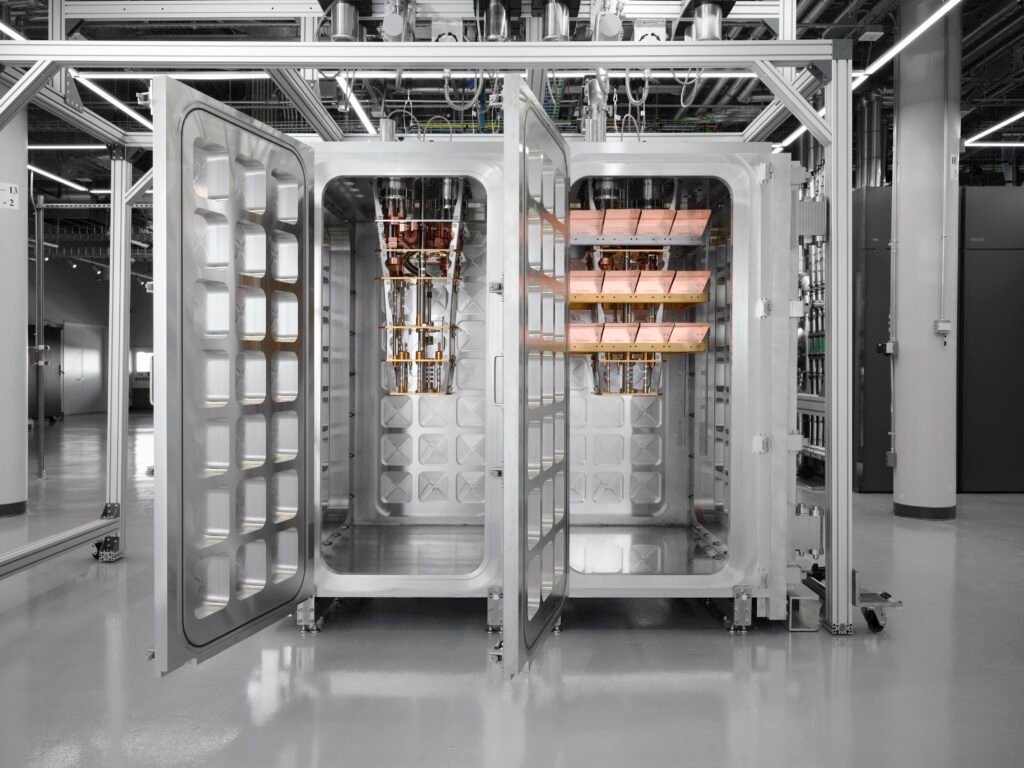
On August 19, 2026, IBM said it had successfully connected and cooled two large cryogenic modules into a single working environment — the first real-world test of a modular cooling architecture the company says can eventually link hundreds of quantum chips together. It’s a step toward IBM Quantum Starling, the fault-tolerant quantum computer IBM has promised by 2029.
No new chip. No new qubit record. Just a very cold box that got bigger without falling apart — and that’s a much bigger deal than it sounds.
What Did IBM Quantum Starling’s Cryogenic Milestone Actually Involve?
Strip away the jargon, and here’s what happened: IBM took two cryogenic modules — essentially industrial-grade refrigerators built for quantum hardware — and joined them into one shared environment.
The results:
- Combined, the two modules stand over 8 feet tall and 8 feet wide
- The system cooled to 4 Kelvin (about the temperature of liquid helium) in under five days
- It then dropped to below 15 millikelvin — IBM says that’s more than 180 times colder than deep space
- Each module’s enclosure offers up to 12 times more wiring space than IBM’s current production quantum systems
- That extra space allowed for more direct connections between chips, both inside a single module and across separate ones
That last point is the one worth sitting with. Everything else is essentially confirming the physics still works at a bigger scale. The wiring number is the one that tells you whether this thing can actually grow.
Why This “Boring” News Is a Big Deal for IBM Quantum Starling
Here’s the part most coverage will skip: getting a quantum chip cold isn’t the hard part anymore. IBM’s been doing that for years.
The hard part is fitting everything else in.
Every qubit needs control wires and readout wires running into that ultracold environment. Add more chips, and you don’t just need more cold space — you need dramatically more wiring, packed in tighter, without any of it leaking heat or noise back into the system and ruining the whole point.
That’s the actual test IBM just ran. Not “can we get colder,” but “can we get bigger without the wiring turning into an unmanageable mess.” Twelve times more wiring room per module is the number that tells you this design can scale. Fifteen millikelvin is just confirmation the physics still holds.
Think of it like server rack density in a data center. Cramming in more servers isn’t hard. Cooling and cabling them without frying the room is the entire engineering problem. Quantum computing just hit its version of that wall — and IBM Quantum Starling‘s design says it found a way around it.
Inside the Cooling Design Behind IBM Quantum Starling
IBM built the modules as box-shaped units meant to sit in a tight row next to each other. That layout creates the physical space needed to connect processors directly using IBM’s “L-coupler” technology — hardware that lets separate quantum chips talk to each other and function as one larger machine instead of isolated islands wired together after the fact.
There’s a smart engineering move buried here, too. IBM says three critical components from its existing IBM Quantum System Two environment are built into the new modules — but restructured so each piece can be tested and improved on its own, instead of forcing a full redesign every time one part needs an upgrade.
That’s the difference between building a single finished product and building a platform you can keep iterating on. IBM is clearly betting on the second one.
Where This Fits IBM Quantum Starling’s Roadmap to 2029 (and Beyond)
This milestone didn’t come out of nowhere — it sits on a roadmap IBM has been building toward IBM Quantum Starling since 2025. Since then, the company says it’s demonstrated core hardware pieces and made progress on faster error-correction decoding.
Here’s where things go from here, according to IBM:
- Later in 2026 — IBM installs its Quantum Nighthawk processors into these new cryogenic modules for real performance testing
- By 2027 — L-couplers link multiple processors into a system with at least 1,000 “programmable qubits” (qubits that can be directly used to run computations)
- By 2029 — Starling arrives: roughly 200 logical qubits and 100 million quantum gates, fault-tolerant by design
- 2033 and beyond — a follow-up system called Blue Jay, targeting around 2,000 logical qubits and a billion gates
Quick but important distinction: a “logical qubit” isn’t one physical qubit. It’s a cluster of physical qubits working together through error correction to behave like a single, far more reliable qubit. That’s why 200 logical qubits in 2029 isn’t a small number next to today’s physical qubit counts — it’s a completely different, much harder thing to build.
Why 100 Million Gates Matter More Than 200 Qubits for IBM Quantum Starling
It’s tempting to fixate on the qubit number. IBM’s own roadmap argues against that.
Starling’s real target pairs 200 logical qubits with 100 million quantum gates — and that second number matters more, because it’s what actually determines how long and complex a calculation the machine can run before errors pile up and wreck the result.
Useful quantum computing comes down to qubit count, error rates, circuit depth, and error correction working together — not qubit count by itself. This cryogenic milestone is infrastructure in service of exactly that equation. More wiring headroom per module is what eventually lets IBM run deeper, longer, more reliable computations instead of just flashier spec sheets.
The $10 Billion Bet Behind IBM Quantum Starling
None of this comes cheap. In June 2026, IBM committed more than $10 billion over five years toward quantum R&D, manufacturing, capital spending, partnerships, and acquisitions.
This cryogenic milestone is a visible result of that spending. But be careful how you read it — the dollar figure proves IBM is serious, not that the economics of fault-tolerant quantum computing will eventually work out. Those are two different questions, and only time answers the second one.
What This Milestone Proves — and Doesn’t
What’s confirmed:
- Two large cryogenic modules can be joined and cooled together on schedule
- The new design genuinely offers more wiring room than IBM’s current systems
- Existing System Two components can be adapted into a more modular, independently upgradeable form
What’s still an open question:
- Whether Nighthawk processors actually perform well once they’re installed inside these modules later this year
- Whether L-coupler connections hold up as more chips get added, not just two modules
- Whether the 1,000-qubit target for 2027 arrives on time
- Whether error-correction decoding — the classical computing side of this — can keep pace as the system grows
The fridge works. That’s real progress for IBM Quantum Starling. Whether everything built on top of it works just as well is still open.
Key Takeaways
- IBM connected and cooled two cryogenic modules into one system on August 19, 2026, reaching below 15 millikelvin — a step toward its 2029 fault-tolerant quantum computer, Starling
- The real story isn’t the temperature — it’s that each module offers 12x more wiring space than IBM’s current systems, which is what actually allows the design to scale
- IBM plans to install Nighthawk processors into these modules later in 2026, then scale to 1,000+ programmable qubits by 2027 using its new “L-coupler” chip-to-chip connections
- Starling itself targets 200 logical qubits and 100 million quantum gates by 2029 — the gate count matters more than the qubit number for real-world usefulness
- IBM has backed this roadmap with a $10 billion, five-year investment announced in June 2026
- This milestone proves the cooling and wiring architecture works — it doesn’t yet prove the processors, error correction, and scaling targets built on top of it will hold
FAQs
What is IBM Quantum Starling?
Starling is IBM’s planned fault-tolerant quantum computer, targeted for 2029. It’s designed around roughly 200 logical qubits and 100 million quantum gates, built on a modular architecture that links multiple quantum processors together.
What did IBM actually announce in August 2026?
IBM connected two large cryogenic cooling modules into one shared environment and cooled the combined system to below 15 millikelvin. It’s an engineering test of the modular cooling design IBM needs to scale toward Starling — not a new chip or qubit announcement.
What’s the difference between a physical qubit and a logical qubit?
A physical qubit is a single quantum bit, and it’s inherently noisy and error-prone. A logical qubit is built from many physical qubits working together through error correction, designed to behave like one much more reliable qubit. Starling’s “200 logical qubits” target represents a far more advanced unit than 200 physical qubits.
Why does cooling matter so much for quantum computers?
Superconducting qubits, the type IBM uses, only function at extremely low temperatures. But the harder problem isn’t reaching that temperature — it’s fitting enough wiring and interconnects into the cold environment to link many chips together without introducing heat or noise that breaks the system.
When will IBM’s Starling quantum computer be ready?
IBM is targeting 2029 for Starling’s delivery. Before that, its roadmap calls for installing Nighthawk processors into the new cryogenic modules later in 2026, then reaching a system with at least 1,000 programmable qubits by 2027.
How much is IBM investing in quantum computing?
IBM announced in June 2026 that it plans to invest more than $10 billion over five years across quantum research, manufacturing, capital expenditure, ecosystem partnerships, and acquisitions.